


Your Professional Two-Way Radio Supplier
Nan'an Chitai Trading Co., Ltd. was established in 2014 and is a leading supplier of professional communication equipment, including walkie-talkies and electronic products. Our company has a dedicated research and development team of over 100 specialists and operates a state-of-the-art research base covering 500 square meters. We take pride in our comprehensive production process, from R&D to delivery, ensuring product quality at every step. Located in Quanzhou, Fujian, along China’s Maritime Silk Road, we leverage advanced manufacturing capabilities to serve global markets.


Why choose us
Customized services
We provide tailored solutions based on customer drawings or samples, ensuring that products meet specific needs. Our flexibility allows us to meet unique market demands while maintaining high-quality standards.
Quality Control
From raw materials to finished products, we adhere to strict quality control processes, ensuring every product meets high performance and reliability standards.
After-Sales Support
Our professional technical team is available to resolve any after-sales issues, offering excellent customer service and technical support to ensure a seamless user experience.
Dmr Walkie-Talkie
Digital Mobile Radio (DMR) is a digital radio standard for voice and data transmission in non-public radio networks. DMR, along with P25 phase II and NXDN are the main competitor technologies in achieving 6.25 kHz equivalent bandwidth using the proprietary AMBE+2 vocoder. DMR and P25 II both use two-slot TDMA in a 12.5 kHz channel, while NXDN uses discrete 6.25 kHz channels using frequency division and TETRA uses a four-slot TDMA in a 25 kHz channel.
|
Supported frequency |
D:B1/ B3/ B5/ B8 / B34 / B38/ B39/ B40/ B41 |
|
Charging |
Type-C charging connector USB charging and data transfer |
|
Battery capacity |
Large battery 2500 mAh |
|
Dimensions |
55*20*14mm |
|
Calling |
Private Call/Group Call |
|
Positioning |
GPS positioning (optional) |
|
Network |
Support for 4G networks |
|
Voltage |
Rated voltage: 2.1V |
Improved Audio Quality
DMR radios have better audio quality when compared to analog. Their improved quality is because of the audio processing techniques used in DMR. They include noise reduction and error corrections, which make it possible for users to communicate clearly. Even in noisy and crowded environments, you can communicate well.
Better Range and Coverage
DMR radios can travel longer distances and still maintain signal integrity. DMR radio signals can also penetrate walls better. These digital radios can prevent interference, fading, and other problems that can be affected by analog ones.
Superior Battery Life
DMR radios only send or receive using a one-time slot. Thus, your radio will be inactive when another user uses the second time slot. Thus, DMR radios consume less power and have longer battery life.
Advanced Privacy and Security Features
DMR walkie-talkies have improved privacy and security features such as AES256 encryption. To prevent interception, add digital encryptions to your voice and data transmissions. These privacy features also help organizations in protecting sensitive information.
Text Messaging and Data Transmission
DMR doesn’t limit you to voice communication. Instead, you can also communicate through text and data. You can also share GPS locations or send telemetry information to a receiver.
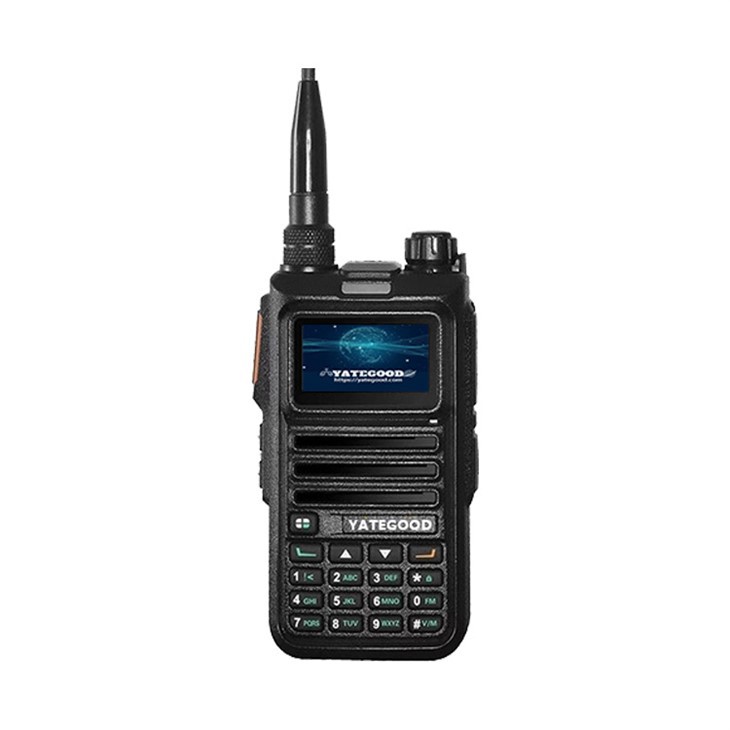
Improved Audio Quality: DMR radios have better voice quality than analog radios. Digital audio processing reduces background noise and reconstructs signals from degraded transmissions. Therefore, users can communicate even in difficult conditions.
Improved range: DMR radios offer greater radio signal penetration capacity by being able to penetrate buildings and other obstacles, increasing their range.
Better battery life: DMR uses time division multiple access (TDMA) technologies that reduce power consumption. A call uses only one of the two time slots, so it uses less energy. Consequently, this increases the battery life.
Advanced privacy and security features: DMR supports modern digital authentication and encryption methods. Prevent other users from listening to your call. This feature makes communication more secure and private.
Applications of Dmr Walkie-Talkie
Emergency Services and Public Safety
Emergency services and public safety agencies prefer DMR two-way radios. They support critical communication and are reliable. Because DMR radios have sound audio quality, users in this sector can communicate clearly.
Business and Industrial Use
DMR walkie-talkies are great for business and industrial use. Construction, manufacturing, logistics, and hospitality industries can benefit from the enhanced features and performance of DMR radios.
Outdoor Recreation and Adventure
DMR radios are also ideal for use outdoors as they help you communicate in remote locations where mobile signals can’t reach. Besides this, DMR radios have a better range and battery life, so users can stay connected while hiking, camping, or engaging in other outdoor activities.
Event Management and Coordination
During events, personnel like security and event planners communicate using walkie-talkies. DMR radios make talking at huge events smoothly and easy, thus reducing the impact of the crowd and noise on communication. Fortunately, DMR radios can travel longer distances and penetrate obstacles, so are better suited for managing the event.
DMR vs. Analog Walkie-Talkies
Enhanced audio quality
DMR radios have better voice quality than analog. Digital audio processing reduces background noise and reconstructs signals from degraded transmissions. Hence, users can communicate even at the edge of coverage.
01
Improved range
DMR radios can penetrate through buildings and other obstacles. And this increases their coverage area.
02
Greater capacity
DMR uses Time Division Multiple Access (TDMA) technologies that allow more users to communicate simultaneously, on the same frequency.
03
Better battery life
TDMA lowers power consumption in DMR radios. A call uses only one of the two-time slots, so it uses less power. Consequently, this will increase battery life.
04
Advanced privacy and security features
DMR supports modern digital encryption and authentication methods. It prevents other users from listening in on your call. This feature makes communication more secure and private.
05
Frequency Range and Bandwidth
DMR walkie-talkies operate within the same frequency bands as analog radios. Like analog, they use Very High Frequency (VHF) and Ultra High Frequency (UHF). VHF frequencies range from 136 to 174 MHz, while UHF falls between 400 to 470 MHz.
Modulation Techniques
DMR digital walkie-talkies use a modulation technique called 4-level Frequency Shift Keying (4FSK) to send voice and data messages. The 4FSK involves modulating the carrier frequency to one of four different frequency levels.
Error Correction and Digital Signal Processing
DMR walkie-talkies have one of the best audio quality. Unlike analog radios, DMR uses Forward Error Correction (FEC) and digital signal processing techniques to improve audio quality.
Time Division Multiple Access (TDMA)
DMR radios use Time Division Multiple Access (TDMA). What TDMA does is divide the channel into two-time slots. Each slot usually lasts for 30 milliseconds. The time slot lets two different groups of users talk simultaneously on the same channel. TDMA means more people can speak at the same time. It lowers power consumption and can hence increase the battery life of DMR radios.

Choosing the Right Dmr Walkie-Talkie
Range and Power Output
Radios with higher output cover longer distances. So, if you need to communicate over long distances, go with licensed radios. They have higher power outputs. But you will need a license to use one.
Durability and Build Quality
Do you intend to use your radio in rough areas like construction locations, mountains, or in the woods? Then, you will need a durable walkie-talkie with a rugged structure and an IP rating.
Battery Life
A good two-way radio should last at least 7-10 hours. But, the best battery range will depend on where you want to use the radio and for how long. In case you forget, remember to check for the charging options available to you, such as vehicle chargers or an extra battery pack.
Extra Features and Accessories
Never settle for the first model you see, even if it looks good. Double-check the features and price with other models. Other features to watch out for include encryption, text messaging, GPS tracking, and Bluetooth function.

DMR Tier I: Tier I includes license-free two-way radios in the European Union and the UK with 16 channels between 446 MHz and 446.2 MHz frequency bands. Walkie-talkies under Tier I are low-power radios with a maximum power output of 500mW. These walkie-talkies can be used by small businesses or for recreational activities.
DMR Tier II: It refers to licensed, high-power radios. They typically use frequencies between 136 – 174 MHz band for VHF and 403 – 527 MHz band for UHF. Tier II radios have advanced features like IP connectivity, text messaging, and GPS location tracking. These radios are primarily for professional and industrial settings, and you will require a license to use these radios.
DMR Tier III: Tier III is exclusively for trunked radio systems, which means radios have automatically assigned frequencies rather than having fixed frequencies.
Tips for Getting the Most Out of Your DMR Walkie-Talkie
Familiarize yourself with the features and operation of the device: Read the user manual and ensure you learn how to use the walkie-talkie. Although DMRs are easy to use, it’s best to familiarize yourself with the advanced features.
Use accessories for better performance: Invest in quality walkie-talkie accessories, such as headsets, speaker microphones, and carrying cases. They help improve your walkie-talkie experience and increase the lifespan of your radio.
Keep software and firmware up-to-date: Regularly update your walkie-talkie’s software and firmware to ensure optimal performance and compatibility with other devices.
Practice proper radio etiquette: Radio etiquettes guide two-way radio users on proper communication. These etiquettes include using clear and concise language, listening before transmitting, and identifying yourself when on a call.
FAQ
We're well-known as one of the leading two-way radio manufacturers and suppliers in China. Please feel free to wholesale customized two-way radio from our factory. For more cheap products, contact us now.